Preparation vs. Procrastination: How to Tell the Difference
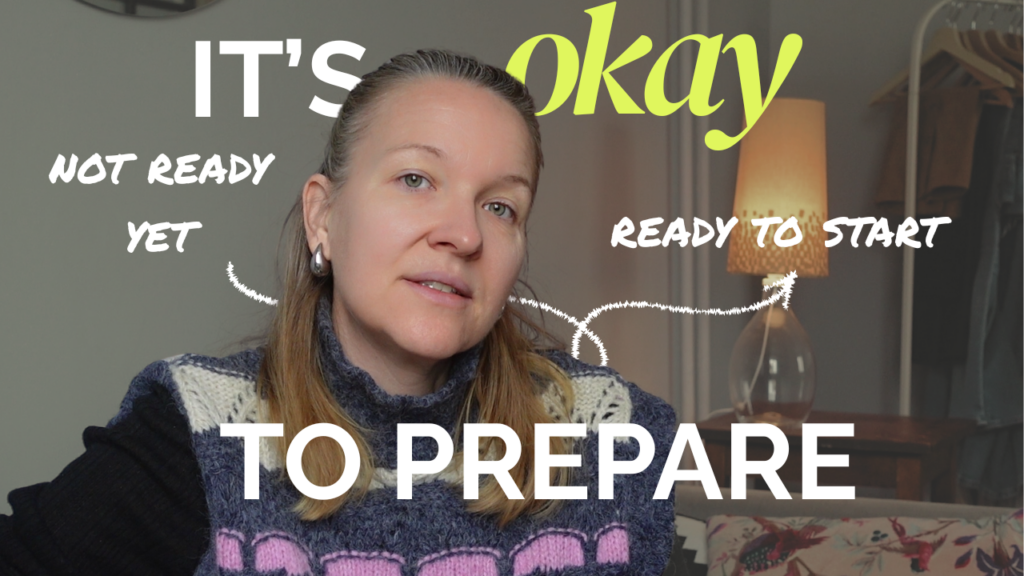
When is preparation genuinely helping us move forward, and when is it just another way of putting things off? I’ve been exploring this question as I prepare to launch a new offer in my business. And I’ve come to realize that the answer isn’t quite as straightforward as we’re often led to believe.
We’re often told that confidence comes from taking action, not from preparing.
Just jump in. Figure it out as you go. You can’t think your way into confidence.
And you know what? I’m actually a big believer in that.
But recently, I’ve been experiencing something that seems to contradict this advice.
I’m preparing for something new in my business, and the preparation itself is helping me build confidence.
So how can both be true?
That’s what I want to explore with you today.
Prefer to watch or listen? I explore this topic in my latest YouTube video, where I share my personal experience and reflections.
When Preparation Actually Builds Confidence
I’m currently preparing to offer website creation services again.
It’s something I’ve done before, something I genuinely enjoy, and something that has been on my mind for quite a while.
But there’s a reason I haven’t pursued it further until now.
The first time around, I didn’t prepare much at all.
People approached me after seeing my own website and asked whether I could build something similar for them.
And I said yes.
Some projects went beautifully. Others were much more difficult.
There were collaborations where expectations weren’t clear, projects dragged on, or the direction changed halfway through.
One experience even ended with me reimbursing a client because I simply couldn’t see a way forward that felt good for either of us.
At the time, I took those experiences quite personally.
I started questioning whether I was actually capable of offering this service professionally.
Maybe I could build websites for myself or friends, but not for paying clients?
And eventually, I stopped offering them.
Looking back, I can see something I couldn’t see so clearly then.
Those experiences weren’t necessarily evidence that I couldn’t do the work. They were information about what was missing from my process.
And that’s a very different way of looking at things.
What If Your Past Experiences Are Showing You What You Need?
Now that I’m preparing to offer website creation again, I’m approaching things differently.
Instead of simply jumping in and hoping everything will work out, I’m looking at what my previous experiences taught me.
What would have made those collaborations easier?
What information would have helped my clients?
Where would clearer expectations, more structure, or better communication have made a difference?
And I’m using those answers to build a more thoughtful service.
I’m creating a clearer process, a questionnaire for potential clients, onboarding materials, and an agreement that outlines what both sides can expect.
Not because I’m trying to protect myself from every possible difficult experience.
That’s impossible anyway.
But because I now have actual experience showing me what can happen when certain things aren’t in place.
And here’s the interesting part:
This preparation is making me feel more confident because it’s based on experience.
I already took action. I already jumped in. I already gathered the information.
Now I’m using what I’ve learned.
So perhaps taking action and preparing aren’t opposites after all.
Sometimes they’re simply different stages of the same process.
How to Tell the Difference Between Preparation and Procrastination
Of course, preparation can become procrastination.
I know how easy it is to keep adding things to the list of what needs to be done before we’re ready.
Another course.
Another certification.
Another website redesign.
Another round of research.
And suddenly, months have passed without us actually putting our work into the world.
So how do we know when we’re genuinely preparing and when we’re avoiding the next step?
One question I’ve found particularly helpful is:
What’s the minimum I genuinely need to have in place before I can move forward?
Not everything that would be nice to have.
Not everything that could potentially become useful one day.
Just the things that would make a meaningful difference.
For my website services, I’ve defined a few essentials.
I want a clear sales page, a simple inquiry process, onboarding materials, an agreement, and three examples of my work that show the variety of websites I can create.
Three examples feel sufficient to me.
Five, eight, or ten?
At this stage, that would probably be unnecessary preparation.
And recognizing that distinction is incredibly helpful.
Because now I know what I’m working toward.
There’s a point where preparation is complete enough, and I can shift my focus toward actively reaching out to potential clients.
Everything else can happen along the way.
You Don’t Have to Wait Until Everything Is Ready
There’s another distinction I find important.
Just because I’m preparing doesn’t mean I’m doing absolutely nothing else.
I’m already talking about my website services.
I’ve mentioned them on Instagram, in my newsletter, on my YouTube channel – and here on the blog.
I’ve added information to my website and even included a little note in my email signature.
Someone who needs a website can already find out that I’m offering this service and get in touch.
And that feels like a wonderful middle ground.
I can prepare the things that genuinely matter while already allowing opportunities to find me.
Once my essential preparations are in place, I can become more proactive about reaching out to people I’d love to work with.
Other ideas, such as joining freelance platforms or expanding my portfolio, can happen in parallel.
They don’t need to become additional conditions for getting started.
I think this is something we sometimes forget when we talk about taking action.
It doesn’t always have to be all or nothing.
Why Setbacks Don’t Have to Mean You’ve Failed
Something else has shifted for me during this process.
I’ve been thinking about how often we make difficult experiences mean something about ourselves.
A project doesn’t work out.
A client isn’t happy.
An offer doesn’t sell.
And instead of asking what happened and what we could learn, we conclude:
Maybe I’m not good at this.
Maybe I’m not cut out for entrepreneurship.
Maybe I should just stop.
I certainly recognize that pattern in myself.
But I’ve started looking at entrepreneurship a little differently.
What if things not working out the first time is simply part of the process?
What if the purpose of those experiences isn’t to prove whether we’re capable, but to give us information we couldn’t have gathered any other way?
That doesn’t mean ignoring mistakes or refusing to take responsibility.
Quite the opposite.
It means taking the experience seriously enough to learn from it, rather than turning it into a judgment about our worth.
And I find that incredibly liberating.
What If Procrastination Isn’t Always the Enemy?
There’s another layer to this conversation that I find equally interesting.
In the world of personal growth and entrepreneurship, procrastination has become something of a villain.
We’re constantly encouraged to overcome it, eliminate it, and push through it.
But I’ve been wondering whether we’re sometimes approaching the whole thing from the wrong angle.
Because we’re human beings.
We’re not machines designed to be productive every moment of every day.
Sometimes we need rest.
Sometimes we need more time.
Sometimes we’re overwhelmed, uncertain, or simply not ready to take a particular step.
And sometimes, yes, we’re genuinely avoiding something we want to do.
But even then, I wonder whether immediately judging ourselves is particularly helpful.
When I look back at my own life, I can certainly identify periods when I procrastinated.
And yet, I’ve still moved forward. I’ve still achieved things that mattered to me.
So perhaps procrastination isn’t always the catastrophe we make it out to be.
And perhaps there’s something more useful we could ask ourselves than simply, “How do I stop procrastinating?”
What Is Your Procrastination Trying to Do for You?
Here’s a perspective I’ve found particularly helpful:
What if a behavior that seems to be working against us is actually meeting a need we’re not acknowledging?
Let’s say you’re putting off launching an offer.
You know you want to do it.
You have the skills.
And yet, every time you think about taking the next step, you find something else to do.
It’s easy to conclude that you’re self-sabotaging.
But what if you approached the situation with curiosity instead?
What are you getting from not taking that step?
Perhaps it’s a sense of safety.
Perhaps you’re exhausted and need rest.
Perhaps the step you’ve set for yourself feels so enormous that you don’t know where to begin.
Or perhaps there’s something about the way you’re planning to move forward that genuinely doesn’t feel right for you.
I don’t think there’s one universal answer.
But I do think that understanding the need underneath a behavior gives us more possibilities than simply trying to force ourselves to stop.
If you need rest, how could you give yourself rest without abandoning your goals?
If you need safety, what would help you feel safer taking the next step?
If you’re overwhelmed, could you make that step smaller?
Instead of fighting against yourself, you can begin working with yourself.
And to me, that’s a much more sustainable approach to personal growth and entrepreneurship.
Maybe the Goal Isn’t to Stop Preparing or Procrastinating
The more I reflect on this, the more I realize that the question isn’t simply whether preparation is good and procrastination is bad.
There’s so much more nuance.
Sometimes preparation is an essential part of the work.
Sometimes it helps us build confidence because we’re applying what we’ve learned from experience.
Sometimes preparation becomes a way to avoid taking action.
And sometimes procrastination might be pointing toward a need that deserves our attention.
I don’t think we need another reason to be hard on ourselves.
What we need is the willingness to look at our situations with honesty, curiosity, and kindness.
To ask ourselves what would genuinely help us move forward.
And to recognize that building a business, pursuing a dream, or creating a meaningful life doesn’t require us to sacrifice our needs along the way.
Maybe the goal isn’t to eliminate preparation or procrastination. Maybe it’s to understand what we actually need in order to move forward—and find ways to give ourselves that.
And perhaps that changes everything.
A Question for You
Is there something you’re currently preparing for?
Something you’ve been wanting to do, but haven’t quite taken the next step toward?
I’d love to invite you to ask yourself:
What do I genuinely need to have in place before I move forward? And what might I be asking of myself that isn’t actually necessary?
You might be surprised by the answers.
And if you’re currently thinking about creating or refreshing your website, I’d love to hear about your project. I’m preparing my website creation services for coaches, creatives, and heart-led solopreneurs who want an online home that truly reflects them and their work.


You May Also Like

I stopped trying to launch the “right” way | Note from Self week 32

What if there is nothing to figure out?